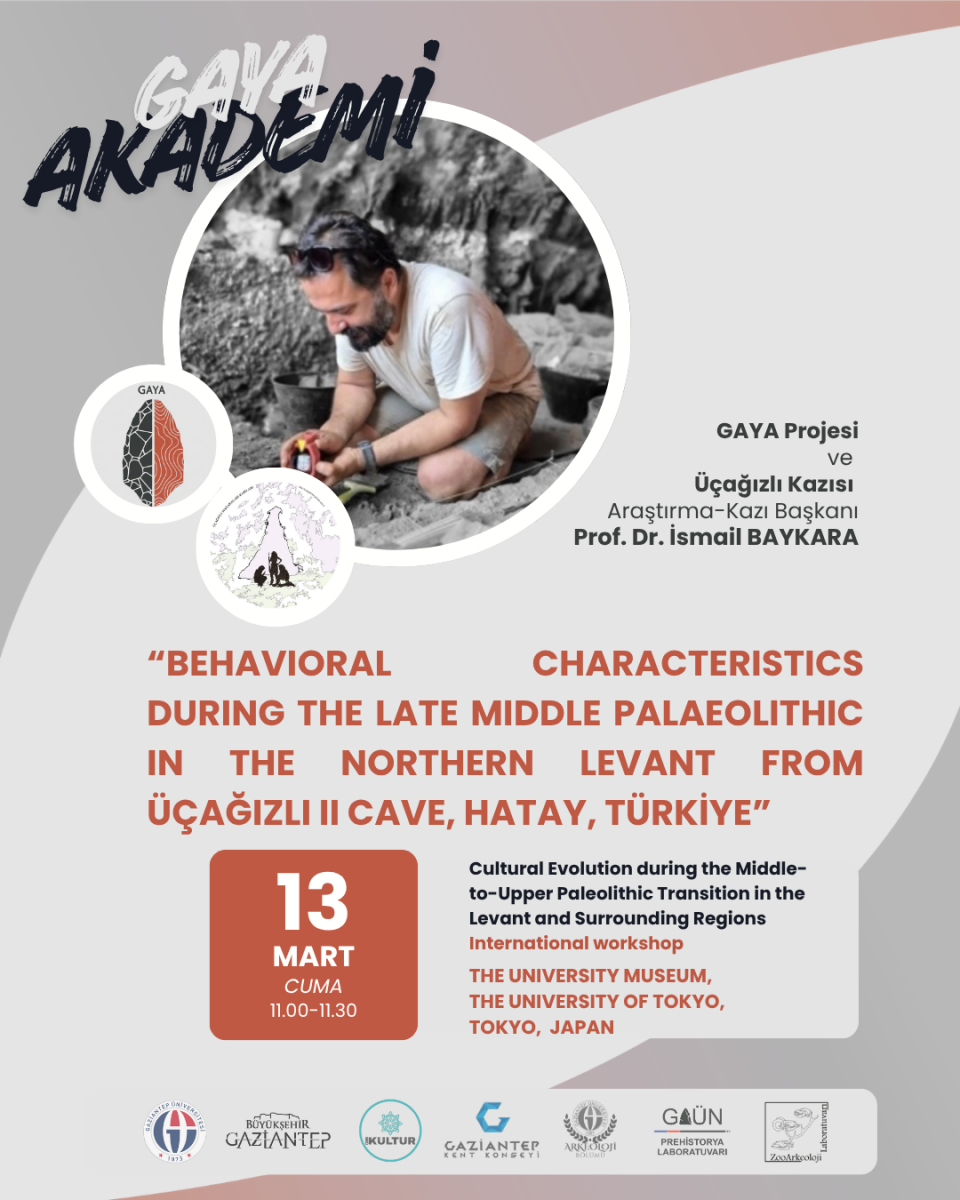
One of the most significant outcomes of the joint scientific work carried out by GAYA Academy and the Üçağızlı Excavations was shared internationally through a presentation by Prof. Dr. İsmail Baykara, Director of both the project and the excavations, at the University of Tokyo. Prof. Dr. İsmail Baykara participated as an invited speaker in an international workshop held in the Japanese capital, titled “Cultural Evolution during the Transition from the Middle to the Upper Palaeolithic in the Levant and Surrounding Regions.” Hosted by The University Museum, The University of Tokyo, this high-level scientific session was held on Friday, 13 March, from 11:00 to 11:30 a.m. It examined the cultural and behavioural transitions between Neanderthal and modern human (Homo sapiens) populations during one of the most significant turning points in human history. At this international forum, attended by leading prehistory specialists from around the world, the prehistoric heritage of Türkiye and the region was presented through the latest research findings.
In his presentation, Prof. Dr. İsmail Baykara shared the latest scientific findings from Üçağızlı II Cave in Hatay, where he leads the excavations and which has made an important contribution to our understanding of Palaeolithic prehistory. His presentation, titled “Behavioral Characteristics during the Late Middle Palaeolithic in the Northern Levant from Üçağızlı II Cave, Hatay, Türkiye,” examined prehistoric human behavioural adaptations and subsistence strategies in the region. The presentation drew on evidence from hearth structures, stone-tool technologies, and faunal distributions documented in the cave’s key archaeological layers.