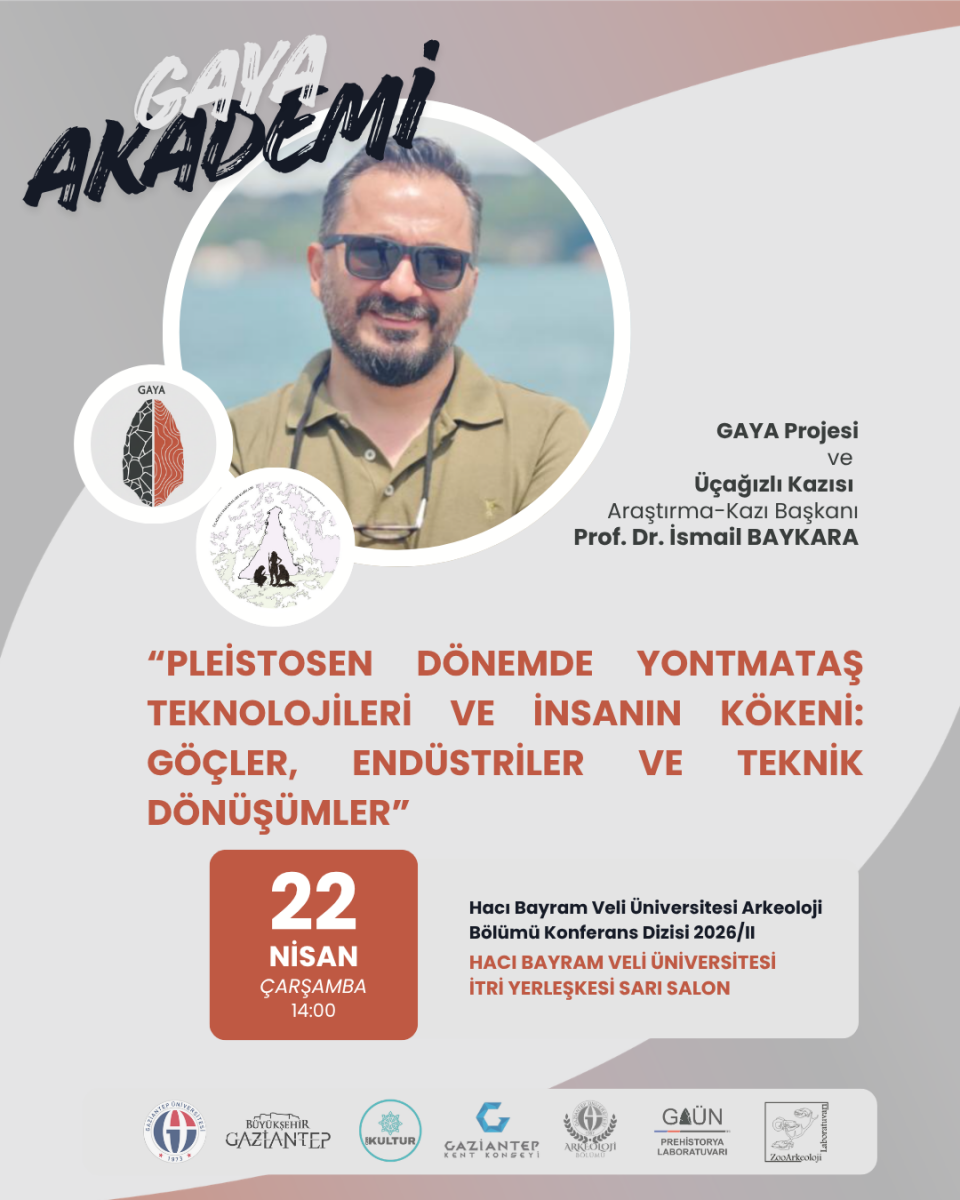
The fourth major academic presentation highlighting the joint scientific work of GAYA Academy and the Üçağızlı Excavations was delivered by Prof. Dr. İsmail Baykara, Director of both the project and the excavations, at Ankara Hacı Bayram Veli University. Prof. Dr. İsmail Baykara participated as an invited speaker in the “Department of Archaeology Conference Series 2026/II” a programme traditionally organized by the university’s Department of Archaeology and featuring distinguished researchers from the academic community. The well-attended conference began at 2:00 p.m. on Wednesday, 22 April, in the Yellow Hall at the İtri Campus of Ankara Hacı Bayram Veli University. The event brought together a large audience of faculty members, graduate researchers, and archaeology students. By bringing the latest discoveries from the GAYA Project and the research conducted at the Üçağızlı Excavations to the capital, the conference provided an opportunity to discuss the technological evolution of humans during prehistory in detail.
In the presentation, titled “Pleistocene Stone-Tool Technologies and Human Origins: Migrations, Industries, and Technological Transformations” Prof. Dr. İsmail Baykara discussed important aspects of one of the longest periods in human history. The presentation brought together the latest Pleistocene stone-tool data from the GAYA field surveys in the Gaziantep region and stratigraphic evidence from the Üçağızlı II Cave excavations in Hatay. It presented, in chronological order, the migration pathways of early human populations, the different stone-tool industries they developed along these pathways, and the technological changes that took place over time. The presentation also examined how early humans’ ability to process raw materials shaped not only their strategies for survival, but also the development of human cognition and social organization. These discussions were supported by images from our laboratory analyses.